
AI Isn’t Changing PR. It’s Rewarding the Ones Doing It Right.
What the Lorelight shutdown and new AI visibility data reveal about the future of PR and brand authority.

When Benjamin Houy announced he was shutting down Lorelight, his GEO (Generative Engine Optimization) platform designed to help brands appear more often in ChatGPT, Claude, and Perplexity — it stopped me mid-scroll.
His reflection summed up what so many in marketing need to hear right now:
“There’s no such thing as a GEO strategy separate from brand building.”
As someone who’s spent my career at the intersection of PR, media, and brand storytelling, I felt that deeply. Because it’s true.
Everyone is scrambling for the next acronym. SEO, GEO… maybe XEO next?
But the brands actually winning in the AI era aren’t relying on a shiny new tool.
They’re relying on what has always worked: authority, credibility, and consistency.
That’s because AI isn’t changing the rules of brand visibility. It’s just finally revealing who’s been playing the long game.
So What’s Actually Different From SEO?
When people hear “AI visibility” it’s easy to assume it’s just the next evolution of SEO. But what’s happening with tools like ChatGPT, Claude, and Perplexity is fundamentally different.
If traditional search rewards web pages, generative AI rewards reputation.
Here’s how the two compare (thank you, Chat):
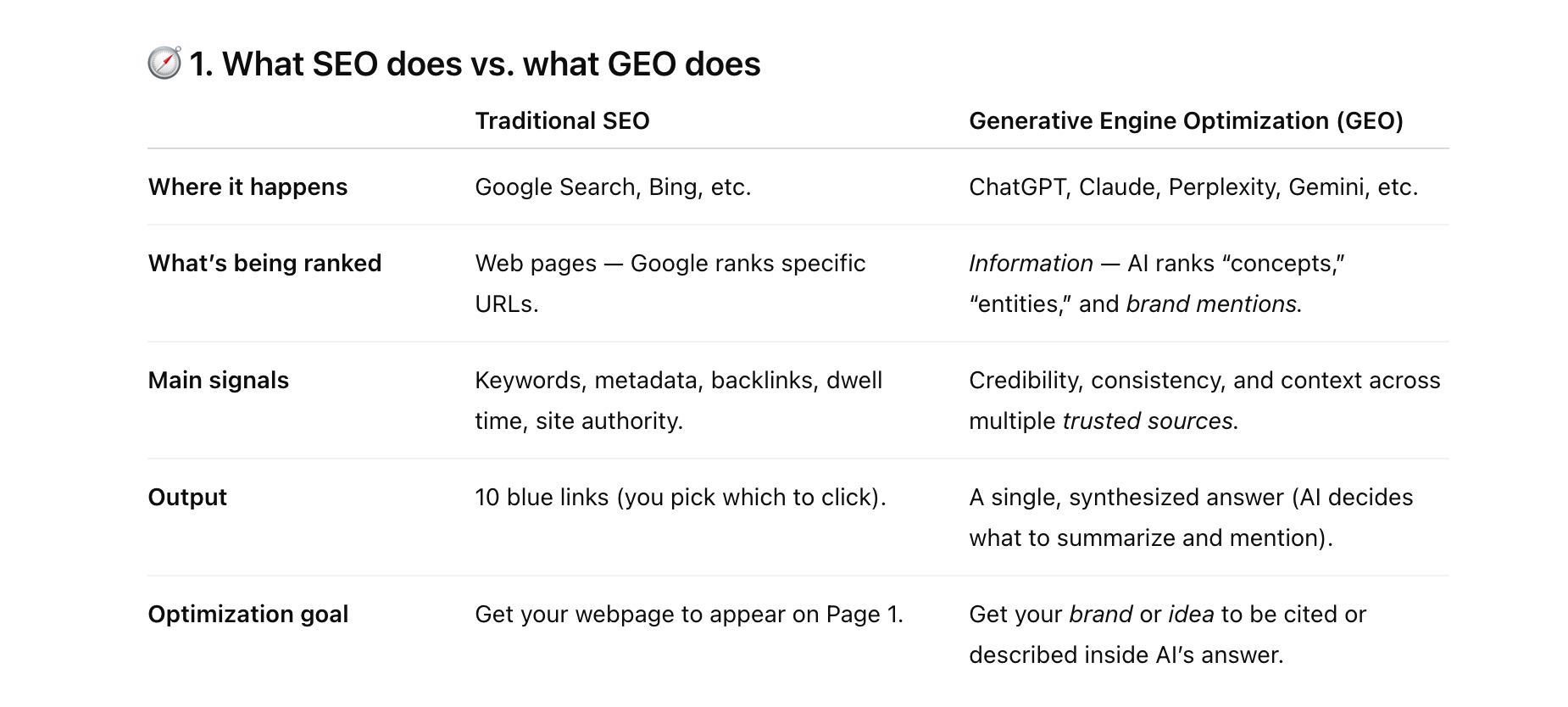
In other words: SEO is about optimizing your website. GEO is about optimizing your reputation and presence across the web.
That shift is subtle but huge, and honestly, has taken me a bit to wrap my head around.
Because AI tools don’t crawl pages to rank them. They synthesize information across trusted sources. So if your brand is referenced by credible media, reviewed by experts, and described consistently across the web, AI learns to associate your name with authority in that category.
That’s why PR and earned media have suddenly become visibility levers again.
Cliff Notes:
SEO = visibility through pages.
GEO = visibility through people talking about you.
PR = the bridge between the two.
If SEO got you seen, PR got you believed.
The Data That Proves It
A 2024 analysis from AirOps reviewed over 21,000 brand mentions across ChatGPT, Claude, and Perplexity and found three key takeaways:
85% of brand mentions in AI search come from third-party sources, not from brand-owned content.
Brands are 6.5x more likely to appear in AI-generated results when they’re referenced externally.
68% of brands only appeared in one AI system, showing how fragmented visibility is and how much consistency matters.
Hence, you can’t trick an algorithm to get AI visibility. It just reflects the visibility they’ve already earned.
Why Lorelight’s Shutdown Matters
At first glance, Lorelight’s closure might look like a founder giving up. But I actually see it as a breakthrough—a needed shift from tool-chasing to truth-facing.
Here’s what this moment teaches anyone in PR or brand building:
The insight was real: brands want to show up in AI-generated answers.
The shortcut wasn’t: you can’t skip the brand equity and third-party credibility those systems reward.
The humility was powerful: “We built a tool for something that doesn’t need a tool.”
It’s a reminder that before buying another “AI visibility platform,” you need the foundation: quality content, trusted mentions, and a consistent message.
However, the GEO Land Grab Has Already Started
If all this feels new, you’re not alone, as most teams are still figuring it out.
But as Noah Greenberg, CEO of Stacker, put it in a recent LinkedIn post:
“There’s about to be a land grab for who owns GEO at every company.”
And he’s right. As brands realize that AI visibility is a new form of search authority, every department (SEO, content, growth, comms) is trying to claim ownership.
For PR, this is the moment to lean in, not back.
The Question Everyone Asks: “How Do You Keep Up With It All?”
Brand founders and PR pros ask me this constantly:
Between AI shifts, affiliate updates, and media changes—how do you keep up?
The truth? You don’t. Not in the sense of tracking every new tool or acronym. What you can do is double down on fundamentals that don’t change.
Here’s the framework I’ve been using and repeating to my team and clients:
1. Anchor on what matters.
Your brand narrative, expertise, and voice are constants. They don’t need to reinvent every quarter.
2. Earn the right to show up.
Focus less on dashboards and more on real people trying your product, posting about it, and journalists writing about it. That’s the signal AI looks for.
3. Strengthen your owned content—but don’t isolate it.
Your site and social channels are your voice, but that voice only travels when others repeat it. That’s where earned media comes in.
4. Filter out the noise.
You don’t need to be everywhere. You need to be everywhere that matters—the spaces aligned with your audience and authority.
5. Build for consistency, not novelty.
The brands showing up across AI models are the ones who’ve been showing up all along.
Case Studies: Real Proof in Motion
Sustainable Home Brand
After steady mentions from sustainability blogs and eco-lifestyle publications via Press Hook, this small brand saw a 43% lift in citations on Perplexity within three months.
No SEO hacks. No GEO dashboards. Just credible third-party coverage that AI could verify.
Functional Beverage Brand
Following a few “Best New Drinks” media features, this adaptogenic beverage brand began showing up organically when users asked ChatGPT, “What are the best drinks for focus and energy?”
Their visibility didn’t come from keywords, it came from trust.
Both examples show how earned media ripples far beyond the article itself.
The Personal Lesson
At Press Hook, I’ve seen this pattern repeat again and again.
The brands seeing lift across AI platforms aren’t chasing every new feature. They’re doing the unglamorous work: building credibility, nurturing journalist relationships, and showing up consistently.
For years, people said PR was too soft to measure.
But now, every time ChatGPT recommends a brand because of something written in Forbes or The New York Times, that’s PR working through a new layer of discovery.
Final Takeaway: Clarity Over Chaos
No one can keep up with every algorithm change or new dashboard. But the brands that consistently show up in media, in search, and in AI answers are the ones grounded in clarity, credibility, and consistency.
Here’s what to remember:
The future of AI visibility isn’t a tool you buy.
It’s not another channel you chase.
It’s the result of doing brand building right.
So, shut down the hype. Focus on the fundamentals: creating ideas worth talking about, building authority, and getting your story told by voices other than your own.
That’s what earns visibility —> in real life and in every AI model that follows.
Just keep swimming, you’ve got this.
- Captain Hook
💌 If you’re rethinking your PR strategy for the AI era, I share monthly breakdowns on how brands can build visibility the right way.
Thank you for writing this article. Your timing on this subject couldn't be better. It provides critical insight into what many without a PR background misunderstand about AI.
You've given the PR community valuable ammunition to counter misguided views on the future of brand equity.
AI isn’t changing PR — it’s revealing what’s been broken for a long time. Most agencies promise the world to win your business, only to say it’ll take six months to see results. But small, authentic brands built on creativity and conviction can’t afford to wait.
The truth is, a product feature doesn’t create a movement. Editors no longer have the freedom to champion what’s new or bold; they’re constrained by the interests of advertisers. So while AI can help write a clever pitch, it can’t replace genuine curiosity or courage — two things that have quietly disappeared from the world of editorial storytelling.
Perhaps that’s why PR feels increasingly irrelevant: not because of technology, but because the soul of discovery has been lost.